2026-08-18T12:32:42.519Z · Cody Hartman
What the 2020 Ice Storm Taught Central Oklahoma Homeowners About Standby Power
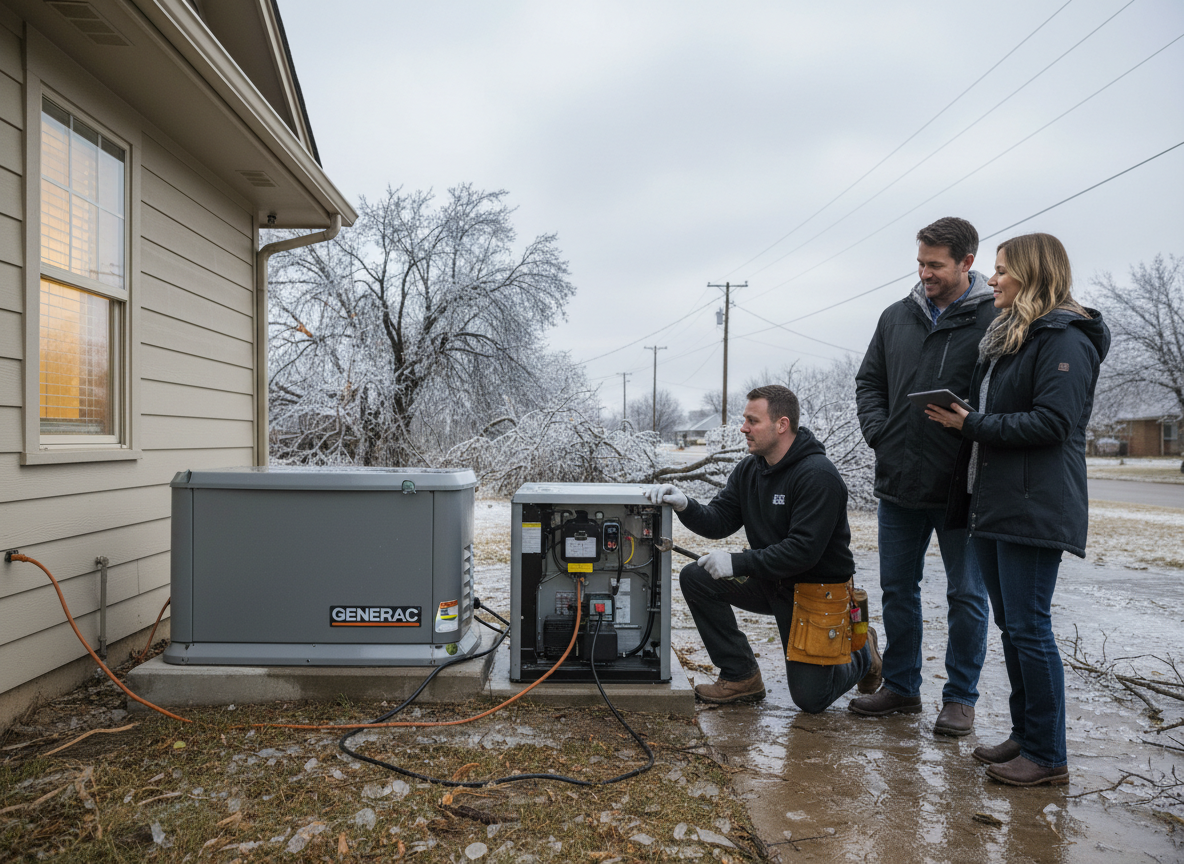
The October 2020 ice storm put parts of central Oklahoma in the dark for days, some rural customers for more than a week, and it permanently changed how homeowners here think about backup power. The lesson was not that outages happen. It was that long outages happen, in cold weather, across the whole region at once, when every generator in every store is already sold.
Why That Storm Was Different
Ice is the grid's worst enemy because it is cumulative. That October, freezing rain coated lines and trees still in full leaf, and the weight brought limbs onto conductors across the metro and the counties around it for 2 days straight. Crews could not restore faster than new damage arrived. Rural customers on long cooperative lines waited longest, for the unglamorous reason that a line serving 8 meters gets crewed after the one serving 800.
For Grady County properties the outage stacked problems: no heat in a cold snap, freezers of beef thawing, and on well water, no water either, since the pump died with the line. That last one separates rural planning from town planning, and it is why generator conversations out here start with the well.
Lesson One: Decide What Must Run, Then Size It
The households that came through comfortably had done the boring arithmetic in advance. A backup plan starts as a list: heat source, well pump, refrigeration, some lights, maybe the internet equipment. Then the sizing is a load calculation, with the key number being the starting current of the biggest motor, usually the well pump or a furnace blower, which can demand 3 to 4 times its running draw for a moment. A generator that runs the list but cannot start the pump is a very loud disappointment.
Two honest paths come out of that list:
- A portable generator with a transfer switch or interlock kit, covering the essentials for a few thousand dollars all in. Manual, fuel fed by gas cans, but transformative in a multi day outage.
- A standby generator with an automatic transfer switch, on propane or natural gas, starting itself whether you are home or not. More money, no effort during the event, and with load management it can run most of a house from a mid size unit.
Lesson Two: The Connection Is the Safety Line
The storm also produced a wave of the worst practice in this field: generators backfed through dryer outlets. A backfed generator energizes the utility's lines through the home's service, which can kill a lineman working what should be a dead line, and it bypasses every protection the panel offers. The legal connection is a transfer switch or an interlock kit, both of which make it mechanically impossible to feed the house and the grid at once. An interlock on an existing panel is a few hundred dollars installed, which is cheap for what it prevents.
Fuel planning is the other quiet lesson. Natural gas customers in town effectively have unlimited runtime. Propane properties need tank math, since a mid size standby can burn 2 to 3 gallons an hour under load and an ice storm outage is measured in days. Portable users learned to store stabilized fuel before the season, because the storm that takes the power also takes the gas stations' pumps.
Lesson Three: Maintenance Is Part of the Machine
Every storm produces the same sad genre of call: the generator that would not start after years of sitting. Standby units solve this with a weekly self test, which gets configured and explained at installation, and portables need a spring and fall habit of running under load. A generator is a plan only if it starts.
What This Looks Like Applied Today
For a town lot in Tuttle: an interlock kit and inlet box on the panel, a quality portable, and fuel discipline, or a mid size standby if budget allows. For an acreage on well water: sizing starts at the pump, propane supply gets checked against multi day runtimes, and load management lets a sensible sized standby carry the house. Either path is permitted, inspected work with a real transfer mechanism, and either one turns the next multi day ice event from a crisis into an inconvenience.
FAQ
How big a generator do I need for a rural house?
Size to the largest motor you must start, usually the well pump or AC, plus the loads that run with it. Many acreage homes land between 14 and 26 kW for whole home standby, or manage with 7 to 9 kW portable for essentials, but the measured load calculation is the real answer.
Is an interlock kit as safe as a transfer switch?
Yes, when installed correctly on a panel that supports one. Both prevent backfeeding mechanically. The transfer switch adds convenience and circuit selection, the interlock wins on cost, and either is legal where the automatic alternative is a standby system.
Propane or natural gas for a standby unit?
Whichever the property has. Natural gas means unlimited runtime in town, propane serves the acreages with tank capacity planned into the design. Diesel and gasoline portables trade fuel logistics for lower purchase price.
If the next ice storm is the one you want to be ready for, the generator installation service, from interlock kits to whole home standby, handles sizing, transfer equipment and the whole permitted install.