2026-08-30T12:32:42.519Z · Cody Hartman
Meter Poles on Rural Acreage: How Power Reaches a House Set Back From the Road
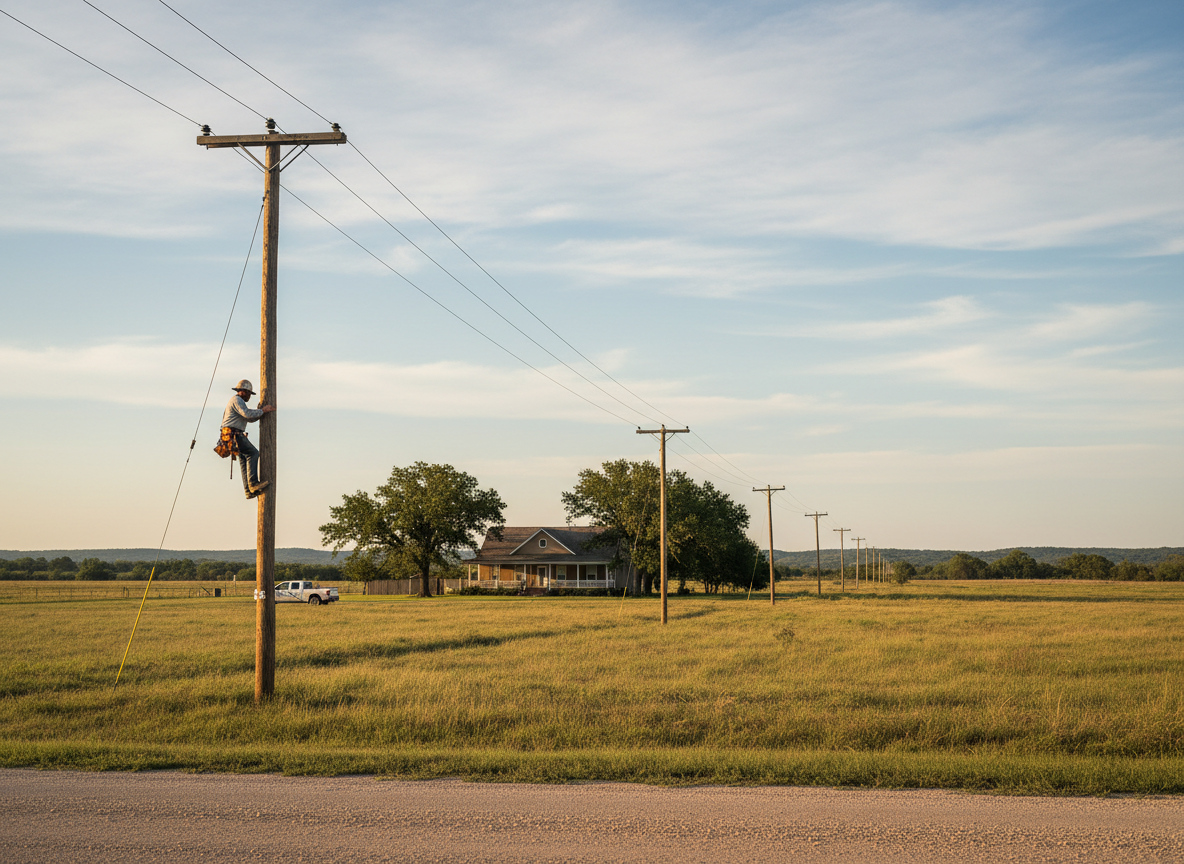
On most rural properties around Tuttle, the utility or co-op brings power to a meter pole near the road, and everything past that pole belongs to the owner: the feeders to the house, the shop and the well, the disconnects, and the grounding at each building. Understanding that layout explains most rural electrical problems, from dim shop lights to the whole property going dark at once.
The Anatomy of a Meter Pole Service
A typical acreage service stacks up like this. The co-op's line ends at the pole, where their conductors meet the owner's riser and weatherhead. The meter base mounts on the pole, often alongside a main disconnect or a small pole panel with breakers. From there, owner owned feeders leave for each building, overhead on spans or underground as direct burial cable or conductors in conduit. Each building that gets a feeder needs its own disconnect and its own grounding electrode, usually ground rods, at that structure.
This is a real distribution system in miniature, and it is why rural electrical work is its own discipline. A town house has one service and one panel. An acreage property might have a pole, a house panel, a shop subpanel and a well circuit, all owner maintained, all aging at their own rates.
Where These Systems Fail
The failure points repeat from property to property:
- The pole itself. Wood poles rot at the ground line and lean after decades of wind. A pole set in the 1980s for a mobile home may now carry a house, a shop and a well it was never planned for.
- Voltage drop. A 200 or 300 foot feeder sized decades ago for lights and a window unit will sag under a welder or modern HVAC. Dim lights and slow motors at the far building are the signature.
- Old direct burial cable. UF cable laid decades back fails with age and moisture, and the fault hides underground until a wet month finds it.
- Missing grounding at buildings. Shops and barns added over the years frequently lack a grounding electrode at the structure, which modern code requires and safety genuinely wants.
- Overloaded pole equipment. Buildings got added, the pole hardware did not grow. A 100 amp pole service feeding 3 buildings is common and often past its practical limit.
Diagnosing Problems on a Pole Service
The method is measurement at each stage. Voltage gets read at the pole, at the house panel and at the far building under load, and the numbers tell the story: full voltage at the pole with sagging voltage at the shop means feeder drop, low voltage at the pole itself points at the co-op's side, and one building dark while others run points at that building's feeder or disconnect. A load calculation across the whole property answers whether the service size still fits the buildings it feeds.
Owners can do one useful piece themselves: walk the pole. Lean, woodpecker holes, rot at grade, rust streaks from the hardware and cracked meter bases are all visible from the ground, and any of them justifies a professional look before storm season tests the pole for you.
When It Becomes a Safety Issue
Three conditions move a pole service from aging to urgent: a pole visibly leaning or soft at the base, since a failed pole drops live conductors across a driveway or pasture; heat, buzzing or burnt smell at the pole equipment, which is failing terminations under load; and repeated breaker trips at a building disconnect, which is a fault or overload asking for attention. Storm damage to any part of the pole assembly belongs to the owner to repair, and the utility or co-op will not reconnect until a licensed electrician has done it and the work has passed inspection under the county or city process.
FAQ
Who maintains the meter pole, me or the co-op?
You do. The utility or co-op owns their line and the meter itself, and the pole, riser, meter base, disconnects and every feeder past it belong to the property owner. That surprises many buyers of their first acreage property.
Why are the lights dim in my shop but fine in the house?
Almost always voltage drop on the shop feeder, either undersized conductors for the distance or a deteriorating connection. It is measurable and fixable, and the measurement should come before any money is spent.
Can my existing pole handle a new shop feeder?
It depends on the pole's condition, the service amperage and what already runs from it, which is exactly what a load calculation and a pole inspection answer. Adding a building to a tired 100 amp pole service is how nuisance problems start.
If your property runs on a meter pole and any of this sounds familiar, the residential electrician service for meter poles and rural feeders covers everything downstream of the co-op's line.