2026-08-22T12:32:42.519Z · Cody Hartman
Well Pump Circuits: Why They Fail and What to Check First
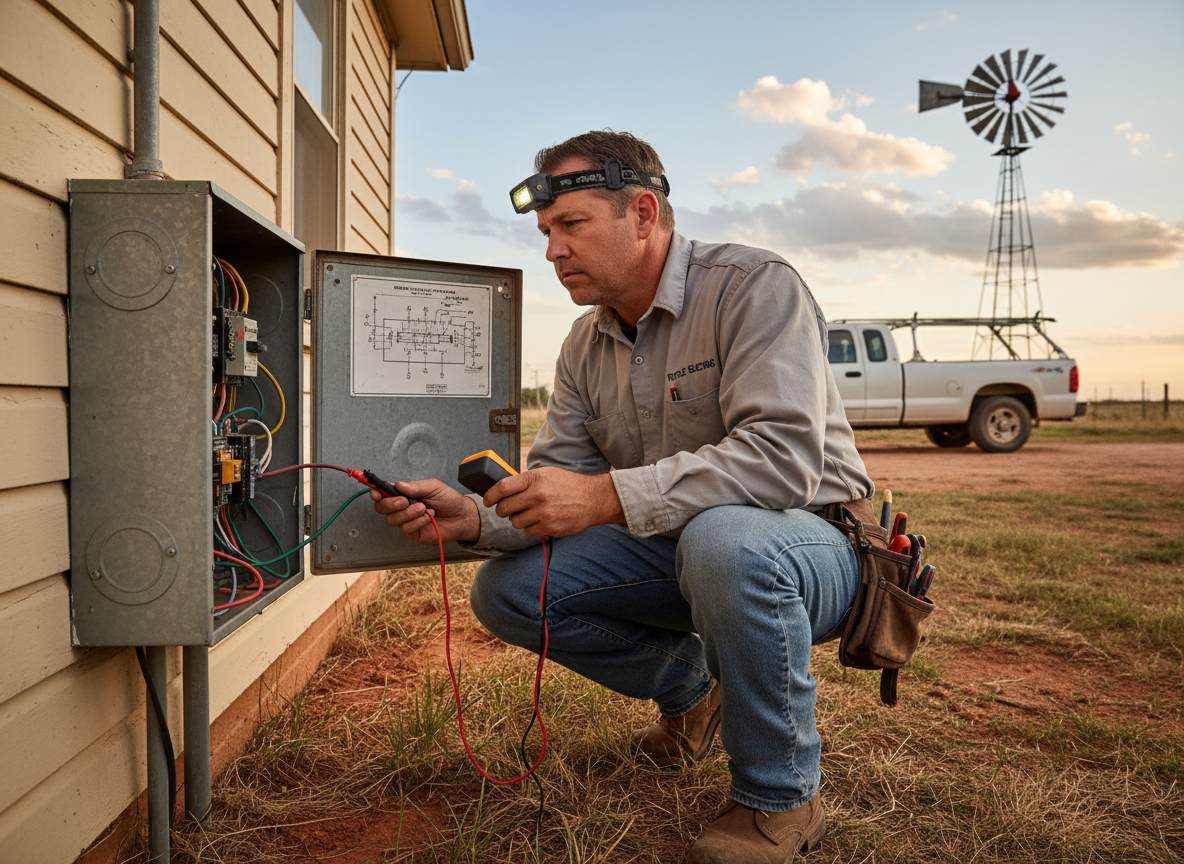
When a well quits, the pump itself is the last suspect, not the first. Most no water calls trace to the electrical chain feeding it: a tripped breaker, a failed pressure switch, a burned pump control box component, or a damaged feeder between the panel and the wellhead. Checking in that order finds the fault cheapest first, and it is the order a professional works too.
How the Circuit Actually Works
A typical submersible well setup around Grady County runs like this: a dedicated 240 volt branch circuit leaves the panel or the meter pole, runs to the well location, and passes through a pressure switch mounted near the pressure tank. The switch is the brain, closing when tank pressure falls to the cut in point, commonly 30 or 40 psi, and opening at cut out. On 3 wire pumps, a control box on the wall holds the starting capacitor and relay that kick the motor; 2 wire pumps bury those components in the motor downhole. From there the conductors run down the well to the pump itself.
Every link in that chain lives a hard life. The pressure switch cycles thousands of times a year, arcing a little each time. The control box capacitor is a wear item. The buried feeder sits in soil that is soaked in spring and cracked dry by August. And the whole system shares Oklahoma's lightning exposure, since long rural lines collect surges and the well circuit is electrically a big antenna ending in a motor.
What Fails, Ranked Roughly by Frequency
- Pressure switch. Contacts pit and burn until one day they do not close, or they weld shut and the pump never stops. A switch is an inexpensive part, and it fails far more often than pumps do.
- Control box capacitor or relay. On 3 wire pumps, a failed start capacitor means the motor hums and trips instead of starting. The box is serviceable without pulling the pump.
- Breaker and connections. A well breaker that trips occasionally in summer may be a real overload; one that trips instantly points at a fault. Loose terminations at the switch or box heat and fail with age.
- The buried run. Chewed, nicked or aged cable between the panel and the wellhead fails intermittently first, often in wet weather, before it fails completely.
- The pump and downhole wiring. Real, but last on the list, and the most expensive, which is exactly why everything above gets ruled out first.
What an Owner Can Check Safely
Without opening anything electrical: check the breaker and reset it once, no more, since a breaker that re-trips is protecting against something real. Look at the pressure gauge by the tank, because a system sitting at 0 psi with the breaker on tells a different story than one holding 50. Listen at the tank when someone opens a tap: a click from the pressure switch that produces no pump sound points downstream of the switch. And after a nearby lightning strike, suspect the surge path even if everything else in the house survived.
Leave the rest alone. The pressure switch and control box carry 240 volts and stay energized in ways that surprise people, and a wet well house floor makes it worse. The dividing line is simple: observing is yours, opening covers is not.
Fixes, Costs and When It Is Urgent
The good news in this niche is that the common failures are the cheap ones. Pressure switches and capacitors are modest parts with modest labor, a control box runs more, and locating and repairing a buried feeder fault costs real money but far less than a pump replacement most of the time. A surge protective device at the panel and, on lightning heavy properties, protection at the well equipment itself is inexpensive insurance for the most surge exposed circuit on the property.
Urgency is about water and stock. A house without water is an emergency in any season, and stock waterers in an Oklahoma summer make it a same day matter. That is why well pump circuits are covered on the 24 hour line rather than treated as business hours work.
FAQ
My pump hums but does not start. What is that?
On a 3 wire pump, the classic sign of a failed starting capacitor in the control box, which is a serviceable part. Turn the circuit off so the motor does not sit humming, and have the box tested before anyone talks about pulling the pump.
Why does the well breaker trip only in wet weather?
That pattern points at insulation breaking down somewhere moisture reaches, most often the buried feeder or a splice at the wellhead. It is locatable with test equipment, and it will not heal on its own.
Should the well be on a generator?
On rural properties, yes, it is usually the load that matters most, since an outage takes the water with it. The pump's starting current has to be measured for the generator to be sized right, which is part of any competent backup power quote.
When the water stops and the breaker tells you nothing, the emergency electrician service for well pump and no water calls covers these circuits any hour of the day.