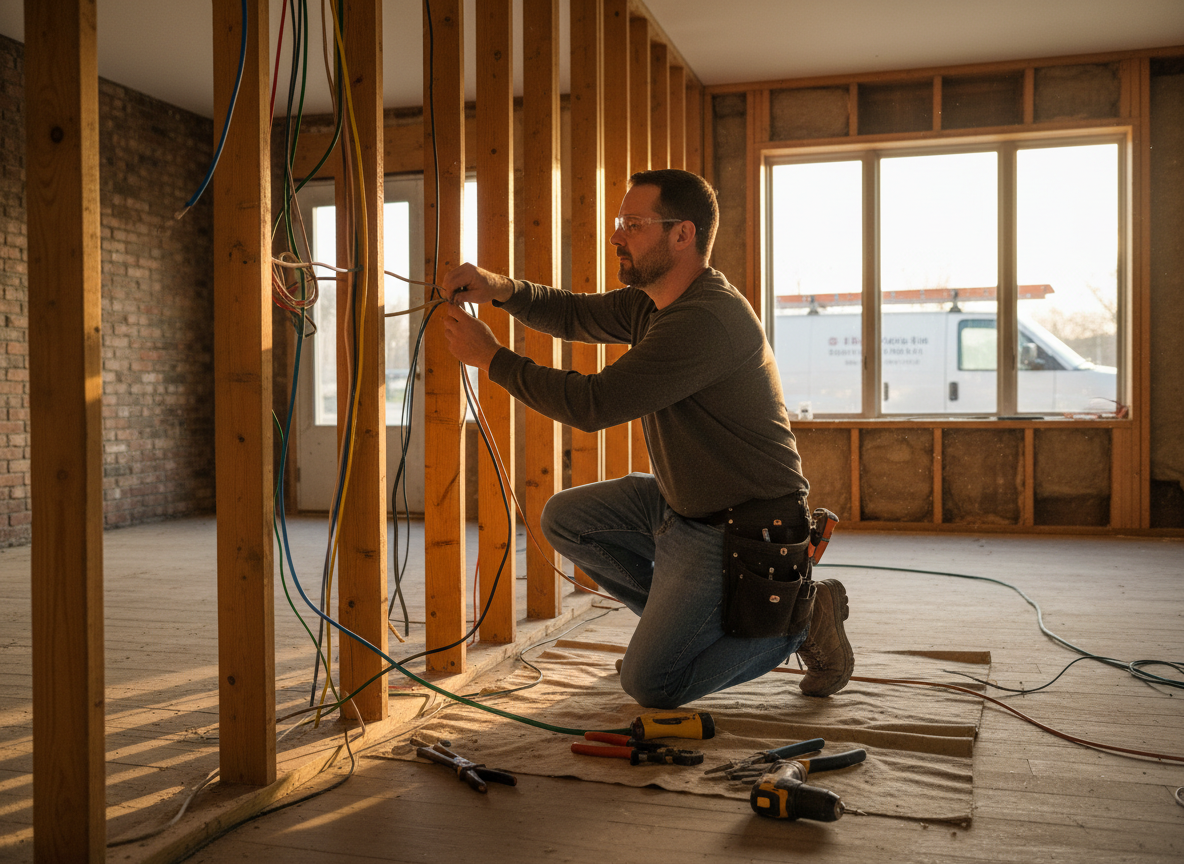
Rewiring is diagnosed before it is sold. The question is what the existing conductors are, not how old the house is. Cloth insulated wiring with brittle, flaking insulation is a genuine rewire candidate, and knob and tube era wiring cannot be buried in insulation or extended. Aluminum branch wiring from the 1960s and 1970s is a different problem with a different fix, since its hazard lives at the connections, and COPALUM or AlumiConn terminations at every device can often make it serviceable without opening every wall. An honest assessment separates the house that needs a full rewire from the one that needs 40 repaired terminations.
Tuttle's older in town blocks hold homes where the original 60 or 100 amp service still feeds cloth wiring through a fuse panel, and attic heat is the local aggravator. Oklahoma attics run brutally hot through 95 to 105 degree stretches, and decades of that bake insulation off conductors at splices and fixture boxes, which is why the first look happens in the attic with the insulation pulled back, not at the switch plates. Rodent damage along acreage crawl spaces is the second local pattern, since chewed NM cable turns up wherever field mice winter under a house.
A rewire is permitted work: through the City of Tuttle Building and Code department inside city limits, with rough in inspection before walls close and a final at the end, and under county and state jurisdiction outside town. The National Electrical Code as adopted in Oklahoma drives what the new work looks like: AFCI protection on the rewired living area circuits, GFCI where wet locations demand it, grounded receptacles throughout, and box fill done properly rather than stuffed.
What the work actually looks like matters to a homeowner. A full rewire in an occupied house runs room by room, fishing new NM cable from attic and crawl space with the fewest wall openings the framing allows, and every opening is mapped and agreed to before it happens. The misdiagnosis to avoid: two prong receptacles alone do not mean the wiring is bad, and a house can sometimes be made safer with a grounded panel, GFCI protection and repaired terminations while a full rewire waits for a remodel, when open walls make it far cheaper.
House Rewiring Services We Offer
✓Whole House Rewiring
Complete replacement of deteriorated wiring with modern grounded circuits, staged room by room so the house stays livable.
✓Partial and Circuit Rewiring
Replacing the specific circuits that are failing, chewed or heat damaged when the rest of the system tests sound.
✓Aluminum Wiring Remediation
AlumiConn or COPALUM style terminations at every device and splice on aluminum branch circuits, the recognized repair short of rewiring.
✓Cloth Wiring Replacement
Replacing brittle cloth insulated conductors found in older in town homes, prioritized by the circuits that carry real load.
✓Rodent Damage Repair
Locating and replacing chewed cable in crawl spaces and attics, with the damaged runs replaced rather than taped.
✓Remodel and Addition Wiring
Wiring for remodels and additions while walls are open, the cheapest moment a house will ever have for new circuits.
How it works
- 1
Assessment
Attic, crawl space and panel are inspected, conductors are identified, and you learn what actually needs replacing versus what tests sound.
- 2
Scope, Map and Price
You get a written plan showing which circuits, which rooms, where openings will be made, and the fixed price, plus the permit filing.
- 3
Rough In and Inspection
New cable goes in, the rough in inspection passes before anything closes, and openings are patched ready for paint.
- 4
Final and Verification
Devices and fixtures land, every circuit is tested under load, the panel directory is rewritten, and the final inspection signs the job off.
Pricing
Price follows access more than square footage: crawl space and open attic homes rewire efficiently, slab homes and finished ceilings cost more, and partial rewires scale to circuit count. The written price follows the assessment.