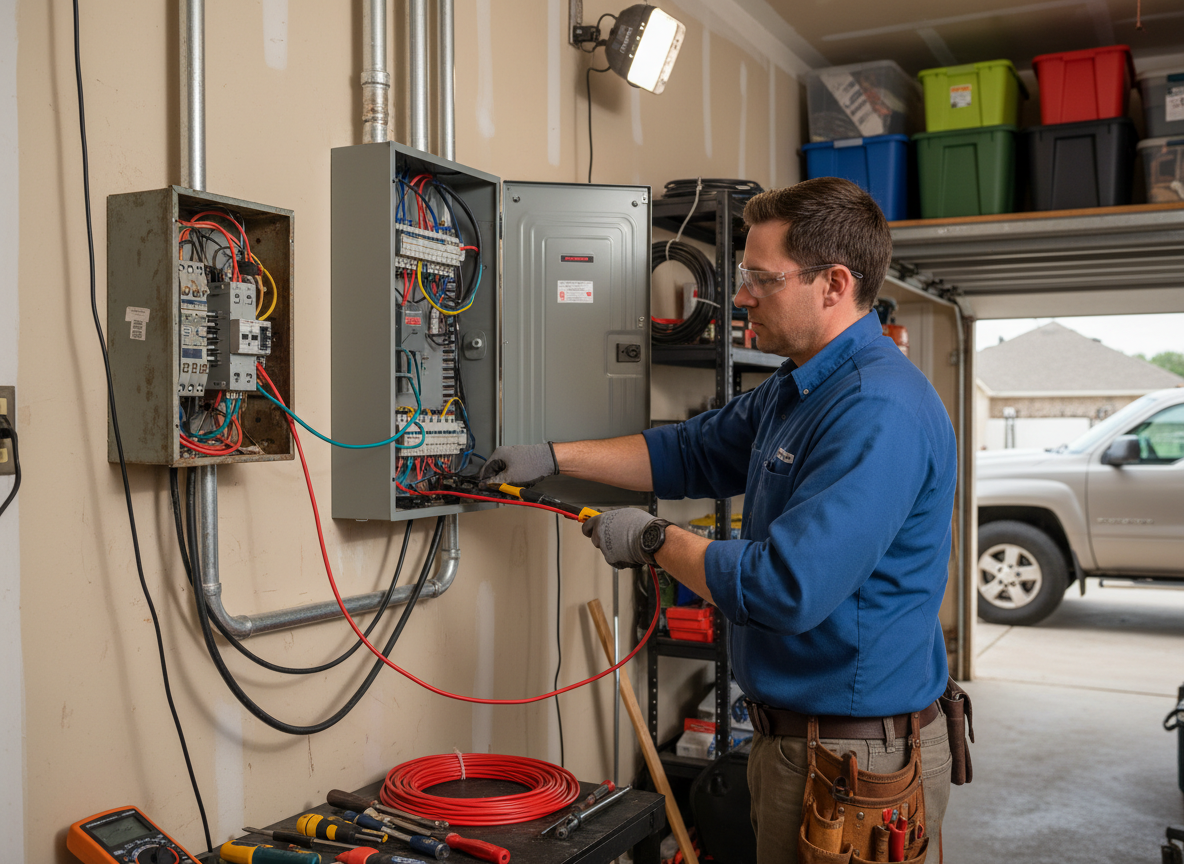
A panel upgrade is a capacity project, not a repair. It starts with a load calculation: the house's square footage, appliances, HVAC, and everything planned, from a shop subpanel to a Level 2 EV charger, added up the way the National Electrical Code prescribes. If the total clears what the existing 100 amp service can carry, you do not need the upgrade, and you will be told so. If it does not, the upgrade replaces the panel, the service entrance conductors and usually the meter base so the whole path is rated for the new amperage.
Around Tuttle the demand drivers are specific. Shops and detached garages add welder and compressor circuits that a 100 amp service cannot spare. Summer heat has pushed bigger air conditioning into houses that were sized for window units. EV chargers are arriving as Oklahoma City commuters build along Highway 4 and US 277. And on acreage properties the upgrade often happens at a meter pole rather than a wall, where the pole, the riser and the feeder to the house all get evaluated together, because upgrading the panel without checking a 40 year old feeder just moves the weak point.
A service upgrade is permitted work everywhere: through the City of Tuttle Building and Code department inside city limits, under county and state jurisdiction outside. It also requires utility coordination, and this is where the OG&E versus cooperative split matters. The utility or co-op disconnects at the transformer, the new service is built and inspected, and reconnection happens only after the inspection passes. That sequencing is arranged in advance so a house is not left dark waiting on paperwork.
What experience adds: aluminum service entrance conductors are fine when sized and terminated correctly, so an upgrade quote should not scare you into copper you do not need. A 200 amp panel with 40 spaces costs little more than one with 30 and saves a subpanel later. And if the existing panel is a Federal Pacific or Zinsco, the project is quoted as a replacement first and an upgrade second, because the hazard is the panel, not the amperage.
Electrical Panel Upgrade Services We Offer
✓100 to 200 Amp Service Upgrades
The full path upgraded: meter base, service entrance conductors, panel and grounding, permitted and inspected.
✓Meter Pole Service Upgrades
Acreage services upgraded at the pole, including the riser, the pole itself where it has rotted or leaned, and the feeder to the house.
✓Load Calculations
A code method load calculation that tells you whether you actually need more service before you pay for it.
✓Subpanel Additions
Subpanels for shops, additions and kitchens when the service has capacity but the panel is out of spaces.
✓EV Charger Ready Upgrades
Upgrades planned around a Level 2 charger circuit, so the charger install afterward is a short job instead of a second project.
✓Grounding and Bonding Upgrades
Ground rods, grounding electrode conductors and bonding brought to current code during the service work.
How it works
- 1
Load Calculation and Site Review
The existing service, panel, feeder path and planned loads are reviewed, and the load calculation says what capacity the property really needs.
- 2
Written Quote and Permit
You approve a written price, then the permit is filed with Tuttle Building and Code or the county authority, and the utility or co-op disconnect is scheduled.
- 3
The Changeover
The old service comes off, the new meter base, conductors, panel and grounding go in, and circuits are relanded and labeled. Most homes are back on power the same day.
- 4
Inspection and Reconnect
The inspector signs off, the utility or co-op reconnects, and every circuit is verified under load before the job is done.
Pricing
Pricing moves with the service path: a wall mounted overhead service is simplest, meter poles add pole and feeder work, underground laterals add trenching, and messy old panels add reland time. The number is fixed in writing after the site review.