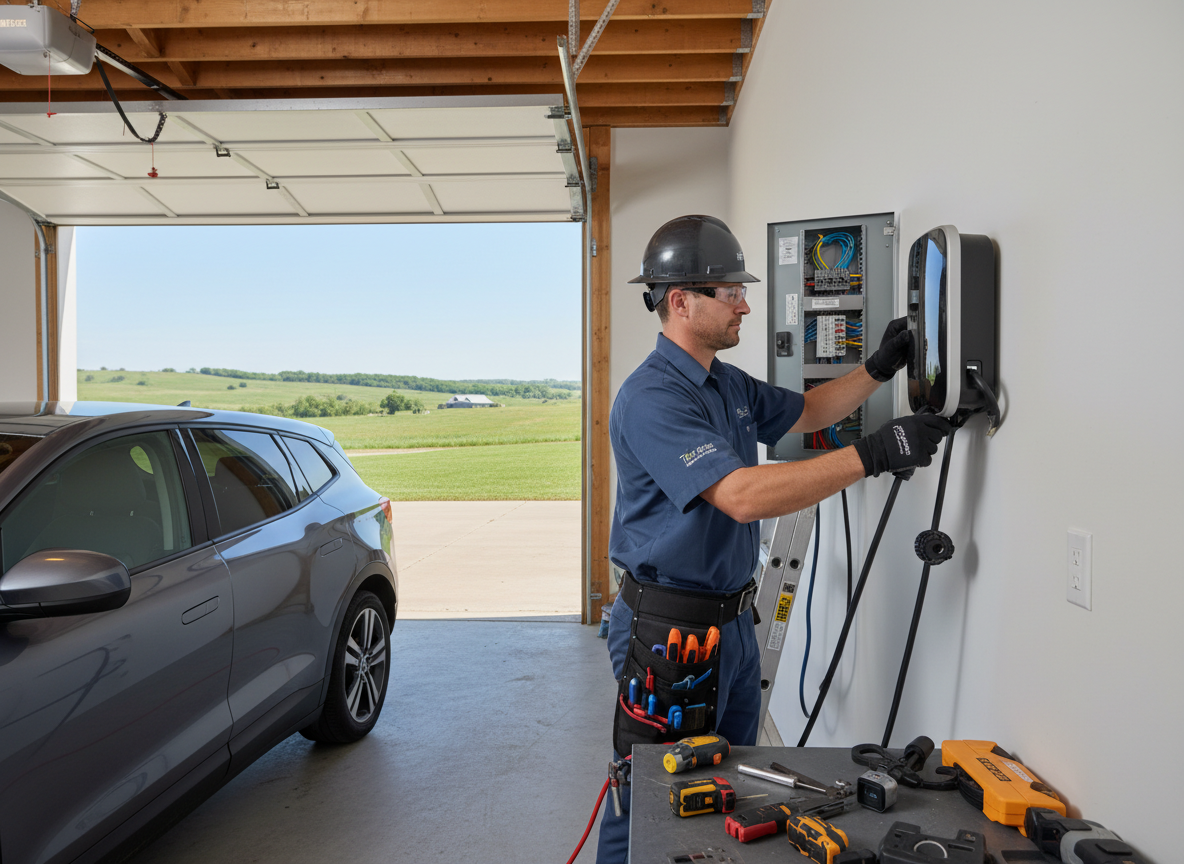
A Level 2 charger install is a load project first and a mounting project second. The charger wants a 240 volt circuit, commonly 40 to 60 amps, and the honest first step is a load calculation against the existing service. Plenty of Tuttle homes on 100 amp services cannot absorb a 48 amp charger on top of central air and an electric range, and the options get laid out plainly: a lower amperage charge rate, a load management device that sheds the charger when the house peaks, or a service upgrade priced as its own decision.
EV work here is growing from a specific direction: commuters to Oklahoma City building new homes around Tuttle, Newcastle and Mustang along Highway 4 and US 277. New construction usually has the panel capacity, and the job is a clean circuit run to the garage wall. Acreage properties add a wrinkle, since the sensible charging spot is often a shop or carport fed by a subpanel, and the feeder to that building, not the main service, becomes the limit. Voltage drop over a 200 foot feeder matters at 48 amps, and a charger that sags below spec will derate itself or fault.
Charger circuits are permitted work, through the City of Tuttle Building and Code department in town and under county and state jurisdiction outside, inspected like any other new circuit. The National Electrical Code as adopted in Oklahoma treats EV charging as a continuous load, which means the circuit is sized at 125 percent of the charger's draw, a detail that catches DIY installs where a 50 amp breaker feeds a 48 amp charger on undersized wire. Hardwired chargers avoid the receptacle failures that cheap 14-50 outlets develop under daily heat cycling.
Field experience worth having: the charger's amperage setting must match the circuit, and most quality units let the installer pin the limit in software or dip switches, which is how a 60 amp capable charger runs safely on a 40 amp circuit today and scales up after a future service upgrade. Outdoor installs on gravel drives get a charger rated for it and mounting that does not rely on siding screws. And if a generator or transfer switch is in the picture, the charger belongs on the non backed up side, because nobody wants a 11 kW charger flattening a standby generator during an outage.
EV Charger Installation Services We Offer
✓Level 2 Charger Installation
Hardwired 240 volt charger circuits, sized at 125 percent of charger draw and inspected, for every major charger brand.
✓EV Load Calculations
The code method calculation that says what charge rate your service can carry before you buy anything.
✓Load Management Devices
Automatic load sharing hardware that lets a charger live on a smaller service by pausing charging when the house peaks.
✓Charger Circuits to Shops and Carports
Charging at detached buildings, with the feeder and subpanel evaluated for the added continuous load and voltage drop.
✓NEMA 14-50 Outlet Installation
Where a plug in charger is preferred, an industrial grade 14-50 receptacle on a GFCI protected circuit, not a budget range outlet.
✓Service Upgrades for EV Charging
Where the calculation says the service is the limit, a 200 amp upgrade planned around the charger so both are one coordinated project.
How it works
- 1
Load Calculation and Site Check
The service, panel space and route to the charging spot are reviewed, and the calculation sets the charge rate the property supports.
- 2
Written Quote
You approve the price for the circuit, the charger mounting and the permit before anything is drilled.
- 3
Installation
The circuit is run, the charger is hardwired and pinned to the correct amperage, and the install is tested at full draw.
- 4
Inspection and Handoff
The permit is closed with inspection, and you get a demonstration of the charger's settings and app before the truck leaves.
Pricing
Pricing follows distance and capacity: a garage wall near the panel is the low end, long runs and detached buildings add cost, and a needed service upgrade is its own line item. The quote is written after the load calculation.